
Soap Calculator
Build a soap recipe from common oils and butters. The calculator works out the sodium hydroxide (or potassium hydroxide) and water you need, the fragrance amount, the total batch weight and the estimated qualities of the finished bar.
- Free to use
- No sign-up
- Runs in your browser

Build your soap recipe
| Oil or butter | Weight | % |
|---|
Soap Recipe Log & Batch Workbook
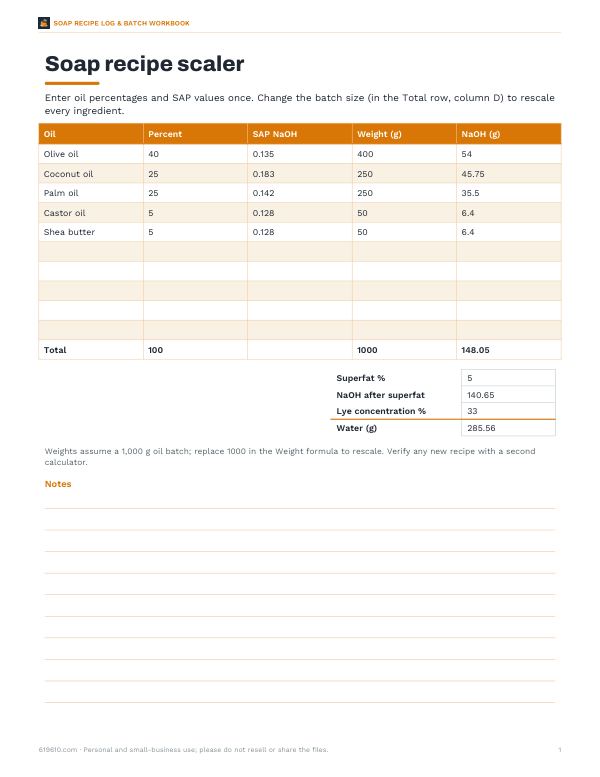
A spreadsheet that scales tested recipes to any batch size, plus printable batch sheets and a cure tracker for your soap studio.
- Recipe scaler workbook (XLSX, PDF)
- Batch record & cure tracker (PDF, DOCX)
Formats: XLSX, PDF, DOCX. Instant download after payment (link valid 72 hours, up to 5 downloads). AI-assisted: the templates were drafted with AI help and reviewed and laid out before publishing.
$5.00 USD, one-time
- Instant download
- 7-day refund
- Secure checkout by Stripe
7-day money-back guarantee. Full refund within 7 days of purchase, even after you download.
Full refund within 7 days — see the refund policy and license.
Free printables
Single sheets you can print right now, no sign-up. The full pack adds every sheet in one download plus the editable files.
How the soap calculator works
Every oil and butter needs a specific amount of lye to turn completely into soap. That amount is its saponification value, or SAP value: the grams of sodium hydroxide needed for one gram of that oil. Coconut oil, for example, needs about 0.183 g of NaOH per gram, while olive oil needs about 0.135 g. The calculator multiplies each oil's weight by its SAP value, adds them up, and then reduces the total by your superfat percentage so a little oil stays unsaponified in the finished bar.
- Lye for each oil = oil weight × SAP value (NaOH).
- Total lye = sum of all oils, then × (1 − superfat).
- For potassium hydroxide, multiply the NaOH amount by 1.403 (the ratio of their molecular weights); for 90% pure KOH, divide by 0.9.
- Water is set from your chosen method: lye concentration, water-to-lye ratio or water as a percentage of oils.
- Fragrance is a percentage of the oil weight.
Always weigh every ingredient, including water, on a digital scale. Volume measures are not accurate enough for soap.
Choosing a superfat
Superfat is the percentage of oils left over after the lye is used up. It protects against measuring errors and makes the bar milder. Five percent is the most common choice for body bars. Salt bars and pure coconut oil bars often use 15–20% because coconut oil is very cleansing. Laundry soap is made with 0–1% superfat so it cleans without leaving oil behind. Liquid soap made with KOH is usually made with a low superfat, around 1–3%, because excess oil can make the finished soap cloudy.
Water and lye concentration
Water dissolves the lye and carries it into the oils; most of it evaporates during cure. The same amount of lye can be dissolved in more or less water.
| Method | Common setting | Effect |
|---|---|---|
| Lye concentration | 28–40% | Higher concentration = less water, faster unmolding, less soda ash, but faster trace |
| Water : lye ratio | 1.5:1 to 2.5:1 | 2:1 is equivalent to about 33% lye concentration |
| Water as % of oils | 30–38% | A traditional default; gives more water for large, low-lye recipes |
Beginners usually start around 33% concentration (roughly 2:1). A “water discount” — using less water — suits recipes with lots of soft oils or intricate swirls where you want more time before trace, only if you understand the trade-offs.
Understanding the bar quality numbers
The quality numbers are estimates built from each oil's fatty acids. They help compare recipes, not predict exactly how a bar will feel.
| Quality | Fatty acids counted | What it suggests |
|---|---|---|
| Hardness | Lauric, myristic, palmitic, stearic | Firm bar that lasts in the shower |
| Cleansing | Lauric, myristic | Strong cleaning and quick lather; too high can feel drying |
| Conditioning | Oleic, ricinoleic, linoleic, linolenic | Moisturising feel; very high values make softer bars |
| Bubbly | Lauric, myristic, ricinoleic | Big, fluffy lather |
| Creamy | Palmitic, stearic, ricinoleic | Dense, stable lather |
The ranges shown are the typical values many soapmakers aim for. A recipe outside a range is not wrong — castile soap made from 100% olive oil is famously low in hardness and cleansing and still makes a good, mild bar after a long cure.
Worked example
The starting recipe is 1,000 g of oils: 40% olive, 25% coconut, 25% palm, 5% castor and 5% shea. The oils need about 145 g of NaOH at full saponification; with a 5% superfat that becomes about 138 g. At 33% lye concentration the water is about 280 g. Three percent fragrance adds 30 g, for a batch of about 1,448 g before cure. The hardness comes out in the mid-40s and conditioning in the mid-50s, both inside the usual ranges — a balanced, beginner-friendly bar.
Safety with lye
- Wear splash-proof goggles and chemical-resistant gloves; keep sleeves long.
- Always add lye to water, never water to lye, in a heat-resistant plastic (#5 PP) or stainless steel container.
- Mix in a ventilated area and avoid breathing the fumes.
- Keep children and pets away and label lye containers clearly.
- Do not use aluminium tools — lye reacts with aluminium.
- Cure cold-process bars for about four to six weeks before use.
Why you should double-check any recipe
SAP values differ slightly between suppliers and references, and a typing error in a recipe can make a harsh bar. Recheck the oil names and weights before you mix, run the recipe through a second calculator if it is new to you, and make a small test batch before scaling up. This calculator gives estimates for hobby use and does not replace product safety testing or regulatory requirements if you sell soap.
Frequently asked questions
What superfat should I use?
5% is a good default for bar soap. Use 15–20% for high-coconut or salt bars and 0–1% for laundry soap.
Can I use this for liquid soap?
Yes, choose KOH. Most KOH sold for soapmaking is about 90% pure, so pick the 90% option unless your supplier says otherwise.
How much fragrance oil should I add?
Many soapmakers use 3–6% of the oil weight, but always follow the maximum usage rate given by your fragrance supplier.
Why is my lye amount different from another calculator?
Calculators use slightly different SAP values and may apply superfat or KOH purity differently. Small differences are normal; large ones usually mean a unit or oil mistake.
Do I need to include beeswax?
Yes, beeswax consumes a small amount of lye and should be entered like an oil. Keep it low, around 1–3%, because it speeds up trace.